
Reggae Revival
When music seeks an identity in crisis.

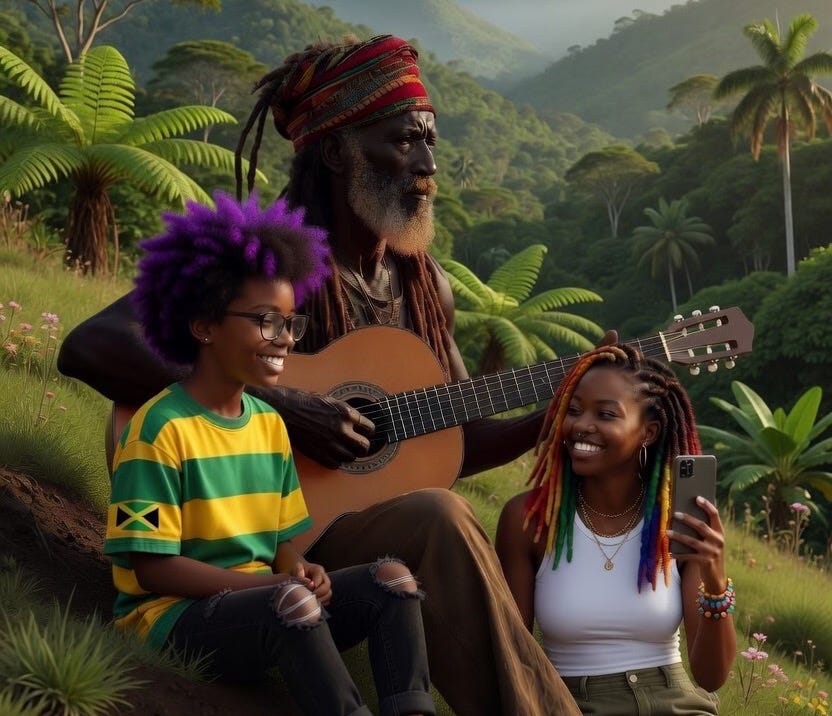
Are Lila Ike and Koffee Rasta? Are they heterosexual? Can they be both, in the same breath? What makes that our business? The curious, peering into the room housing this prodigious elephant are blind to the housekeepers; there’s never a question of Protoje or Chronixx’ sexuality. This spectacle of personhood is the Dutty Bookman-coined Reggae Revival, completing a metamorphosis, emerging from a chrysalis of locks. Dutty Bookman, his moniker a dual nod to his book purveyance and the famous revolutionary, is ideologically a blurred reflection of Mortimo Planno.
Mortimo’s pioneering, belief, and philosophical and physical embodiment of RasTafarianism greatly influenced Bob Marley and the departure of Reggae from dancing to chanting and proselytising. Planno, residing near Marley in Trench Town, and credited with securing The Wailer’s first label contract, had more immediate influence on the music of Marley than Marcus Garvey or Leonard Howell. The nexus of literary and philosophical praxis of Garvey, Howell, Planno and King Selassie I, I consider formal Rastafarianism, herein referred to as Rasta. Reggae and Rasta began their marriage.
Reggae Revival, seemingly divorced from fundamental Rasta, makes pale the influence of Bookman; It was not solely Planno’s influence that shaped Reggae and this is certainly not a lambast of Bookman. Reggae Revival was birthed from Reggae but the parallels are very limited. It’s a fool’s errand on the part of the listener and the critic to seek the lifetime of the parent in their child. I join the fools in the desert chasing the big green tree where the water’s running free, all day in the barren waste, without the taste of water, cool water.
Preceding what we know today as Rasta were individual radicals trekking towards a collective black consciousness, reckoning with the evils recently visited upon their parents and crafting a guide to lifting blackness from the shackles and stains of the great theft of a people. Fitz Balintine Pettersburg, Robert Athlyi Rogers, Leonard Howell aka Ganganguru Maragh, and others converged on a path back to Africa, finding Marcus Garvey en route to royalty and their Kingdom in Ethiopia.
This should be a great irony, but Rasta does not contest the system of a Monarchy nor Empire, the system of power used by white royals to enslave countless Africans. In defence of black royalty, monarchy and empire, as an afro-chinese person, there is no subjugation nor conquest by Black Africans comparable to the evils of white empires. Tafari Makonnen, The Conquering Lion of the Tribe of Judah, His Imperial Majesty Haile Selassie I, is the Royal Monarch to which Rasta is subject, even after his physical death.
An analysis of post-slavery black liberation struggle reveals many great liberators were just as personally troubled as they were righteous for the universal cause. Thomas Sankara married Mariam when she was 16 years old, and Selassie fought against Eritreans independence as well as dimmed Kwame Nkrumah’s socialist ideals. In spite of their earthly transgressions, their people found them.
The same contradictions are present in the cohort of Reggae artists that emerged from/as Rasta. Jah Cure, arrested previously for robbery, rape and gun possession and convicted and jailed for the latter has been most recently convicted and jailed for attempted murder. Jah Cure has made seminal Rasta anthems and was husband to a staple in the Reggae Revival scene. In 2005 police found six AK47’s, three sniper rifles, one M16, two shotguns and one Tec-9 at Sizzla’s Judgment yard. Sizzla veritably inspired a whole generation of youth to become Rastas. Buju Banton made undoubtedly one of the greatest Reggae albums ’Til Shiloh’ and to top it off he spent 10 years in prison for drug trafficking.
To many, these artists’ only redeeming quality is their artistry but nothing takes away from the fact that they are Rasta. Before visa denial became an impediment to their income, artists known as Rasta professed unwavering Rasta values with concrete resolve, tethered to the mansion or house they represented; Mainly Bobo Ashanti, Nyabinghi or The Twelve Tribes of Israel. Uniting them musically in the 2000’s was a spirited offence against oppressive systems, steadfast maintenance of the Rasta creed and a general blazing of fire against an increasingly visible homosexual community.
It must be said that Sizzla, Capleton, Jah Cure, Buju Banton, etc had to bear the weight of an industry and communities that are rife with all forms of abuse and illegalities, from the start of their careers. Add to this environment riches beyond dreams, hordes of yes-men willing to do your bidding at a moment’s notice and women throwing their bodies at you, it’s hard not to develop a God complex.
The young Lila Ike, Blvk H3ro, Runkus, Royal Blue and others wandered, seeking their tribe. Koffee found success before this crop of artists, and some may argue she is not a part of the Reggae Revival. The now Grammy-nominated Lila Ike would eventually be fostered by Protoje, and he and the New Wave movement had a considerable and visible hand in her success today. There is a shadow cast behind their success when they leave the Reggae Revival community and step out into the bright light of stardom, and that shadow is not cast when Sevana, Jaz Elise or Naomi Cowan steps out. Sevana, Jaz and Naomi do not present as Rasta and are known to have heterosexual relationships. Sexuality becomes an undue pressure for Lila and Koffee because they are seen as the daughters of Rasta.
On the inside of the community however, the conflict is unsaid but the flock cries loudly for a shepherd. Chronixx grew into a Reggae star from Dancehall hits, Kabaka Pyramid from Proto-Rap-Reggae and Protoje emulating a sort of Chubby Dread 70’s Rasta, even using the same garrisons as aesthetic props. In a video teaser affirming the intent of his new album, Protoje lobbies for the gardener in a war. There is no Bob Marley figure, no Garvey, no Howell, no Selassie, no 1979 election, none of the material realities that shaped Reggae. The popular music itself changed tone from revolution to satisfaction and liberalism and the community grew to fit.
People now feel comfort that they are not at the mercy of Capleton’s fire and Sizzla’s judgement. Reggae Revival relaxed the rules and created a sanctuary for young open minded people. It is the perfect space for the Jamaican LGBTQ community, upper middle class children who want to piss off their parents safely and the individual afraid of ideologues. Many adopted Rasta aesthetics to feel a part of a greater existence. And for the first time in what was always a masculine space, the feminine is on equal standing with the masculine.
Before the release of Lila’s most recent album Treasure Self Love, Natalie Meade did an interview with her. Natalie was earnestly seeking to confirm something, for her own vindication, as I am in this examination. Listeners wanting to know an artist is par for the course when persons seek to invest more of their time and energy into the art they prefer. This gets magnified when persons try to live vicariously through the artist or wish to share community or fraternal bond with the artist.
A few years ago a series of now deleted tweets by Lila inadvertently helped to solidify the Reggae Revival community into what it isis it now. Inferring, possibly sarcastically, being into women and making Reggae, both industry insiders and queer people closed their respective ranks. Parallel to this was Reggae artist Jah 9 in turmoil with her own Rasta tribe; the collective ostracisation of persons accused of non- heteronormativity helped to affirm Reggae Revival as possible salvation.
In my view, Reggae Revival is seeking a caring demagogue to project, protect, and affirm their identity and community and that’s the long and short of it. They seek a steward for their own Pinnacle. For better or for worse, that may be Lila’s burden.
As fate would have it, Reggae Revival found themselves, like Howell, neatly tucked away on a mountain, their own commune, their Reggae Mountain. Two event spaces owned by principals of Reggae Revival serve as tabernacles through music. Reggae Revival distanced itself from Reggae’s national communal existence to an exclusive experience for a people who sought to separate themselves from the least righteous and the most theological. The communal recording studio is located on a hillside, weh nobody nuh deh fi talk to.
It is my belief that there is no community without work and by your deeds you will be known; you are not part of a community you do not work in. That alone should be instructive to the critics of any movement or culture, Reggae Revival included.
Reggae Revival is their own movement with their own parallels to their parent Reggae; they have their own Planno, their own Pinnacle, but they are also a flock without a shepherd. They are not their father’s child; they have autonomy and agency and decided on a path more accepting than their predecessors but also exclusively inclusive. A terrible weight rests with the shepherd, whoever that is.
Nuff respect to the editor who guided I and I through putting this together sensibly.